How to Sleep Cool in Summer: 5 Mistakes That Are Keeping You Up
DID YOU KNOW? The average person loses about 44 hours of sleep each year due to rising nighttime temperatures [1]. That's nearly two full days of rest, gone.
And when your body can't regulate its temperature overnight, it's not just comfort that suffers. Your deep sleep and REM cycles take the hit too, leaving you tired even after a full night in bed [2].
The good news? Sleeping cool in summer doesn't require a total bedroom overhaul. It takes a few targeted changes, and most of them are things you can do tonight.
Here are the 5 most common summer sleep mistakes and what to do instead.
Mistake #1: Swapping Your Sheets but Ignoring Everything Else
Lighter sheets do feel cooler when you first climb in. But sheets are only one layer in a system that includes your comforter, protector, and mattress.
Your body generates heat all night, and that heat moves downward through every layer. Sleep researchers refer to the thin space between your body and your bedding as the "microclimate," and it's what actually determines how hot or cool you feel overnight [3].
Sheets influence that zone. They don't control it alone.
What to do instead

Think in full layers, not just the top one. Start with sheets built for moisture-wicking breathability.
Bamboo viscose is one of the best performers here. It feels noticeably cooler to the touch than cotton and pulls moisture away from your skin instead of holding onto it [4].
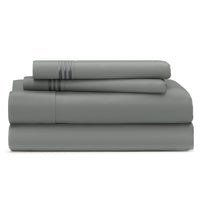
The 100% Bamboo Sheet Set is up to 4x cooler than cotton, according to independent lab testing [4]. The priority is finding a fabric that actively supports your body's cooling process.
Mistake #2: Sleeping Without a Comforter in Summer
It sounds logical: it's hot, so you ditch the blanket.
But your body's core temperature drops to its lowest point between 3:00 and 5:00 am, even in July [5]. Without a cover, you'll likely wake up cold, pull the comforter back on half-asleep, and overheat again by morning.
That hot-cold-hot cycle is one of the biggest disruptors of continuous, restorative sleep [2].
What to do instead

The solution isn't no comforter. It's the right one.
Look for a lightweight option with temperature-regulating fill and a cool-touch shell. You want coverage through that 3 am dip without the heat buildup by sunrise.
The Luxury Down Alternative Comforter wicks heat rather than trapping it, keeping you cool to the touch all night. The principle to keep in mind: keep a light layer on and let the materials regulate for you.
Pro Tip: Place your palm flat on your comforter for 30 seconds. If it feels warm and stuffy when you lift your hand, it's trapping heat. Cool and dry? It's regulating.
Mistake #3: Forgetting What's Underneath You
Your sheets can breathe, and your comforter can be lightweight, but if your mattress is absorbing body heat and radiating it back, you're fighting a losing battle from the bottom up.
This is especially true for memory foam, which has been shown to significantly increase skin temperature compared to innerspring mattresses in warm conditions [6].
Most people assume adding a mattress protector makes this worse. Actually, the opposite is usually true. A breathable protector creates an airflow barrier between you and the foam, intercepting heat before it builds up.
What to do instead
Look for a protector that wicks moisture and promotes airflow rather than sealing heat in.
The Luxury Mattress Protector is 100% waterproof, noise-free, and breathable enough that most people forget it's there (a recurring theme across 700+ customer reviews). It also shields your mattress from summer moisture, extending its lifespan.
Mistake #4: Setting the AC Way Too Low
The ideal sleep temperature is 60 to 67°F [7]. But pushing your thermostat to the bottom of that range when it's 95°F outside means your AC runs nonstop, creating dry, recirculated air that may irritate your throat, sinuses, and skin.
There's also a diminishing return: a room that's too cold increases muscle tension and can actually suppress REM sleep [2].
What to do instead

Set your thermostat to 65–68°F and let breathable bedding handle the fine-tuning. If the room is still running warm, add a fan to improve air circulation.
Moving air and moisture-wicking bedding are among the most effective (and affordable) cooling combinations.
The Cheat Sheet
-
Thermostat: 65–68°F
-
Humidity: 30–50%
-
Fan: toward you, not the wall
-
Bedding: breathable, moisture-wicking layers
Mistake #5: Overlooking Humidity
Temperature gets all the attention, but humidity is often the real problem.
Your body cools itself through the evaporation of sweat. When the air is humid, that process slows down. You're still sweating, but it's not doing its job. That's the sticky, clammy feeling no fan seems to fix.
Even in a room set to 66°F, high humidity can make it feel closer to 75°F to your sleeping body [8].
What to do instead
A small bedroom dehumidifier (aim for 30–50% humidity) can make a surprising difference.
On the bedding side, moisture-wicking fabrics earn their keep here. Bamboo viscose absorbs and releases moisture significantly faster than cotton [4], keeping the air between your body and your sheets drier and more comfortable, even on muggy nights.
Sleep Cooler This Summer

When you work with your body's natural temperature rhythm instead of against it, cooler sleep follows.
Ready to rethink your summer sleep? Our cooling bedding collection is backed by a 90-night risk-free trial, so you can feel the difference before you commit.

Loved Night After Night ⭐ 98% Wouldn't Switch Back* · ⭐ 9/10 Sleep Cooler* · ⭐ 95% Recommend to Friends & Family*
*Based on an independent survey conducted in 2024 (n=2,000)
FAQ: Summer Sleep + Staying Cool at Night
Q: What is the best fabric for staying cool while sleeping?
A: Bamboo viscose consistently ranks among the top cooling fabrics. It scores high in cool-to-the-touch lab testing, wicks moisture efficiently, and is naturally hypoallergenic [4].
Q: Should I sleep without a comforter in summer?
A: Most sleep experts say no. Your body temperature drops in the early morning, so going uncovered often leads to fragmented sleep from repeatedly covering and uncovering yourself [2, 5].
Q: What temperature should my bedroom be in summer?
A: The research-backed sweet spot is 60–67°F. In practice, 65–68°F with breathable bedding balances comfort and energy efficiency [7].
Q: Does a mattress protector make you sleep hotter?
A: A cheap, plastic-feeling one can. But a breathable, moisture-wicking protector creates an airflow barrier that actually helps, especially with memory foam [6].
Q: How does humidity affect sleep quality?
A: High humidity slows sweat evaporation, your body's primary cooling method. Keeping bedroom humidity between 30–50% helps your body thermoregulate more effectively [8].
Resources:
-
Minor, K., Bjerre-Nielsen, A., Jonasdottir, S. S., Lehmann, S., & Obradovich, N. (2022). Rising temperatures erode human sleep globally. One Earth, 5(5), 534–549. https://doi.org/10.1016/j.oneear.2022.04.008
-
Okamoto-Mizuno, K., & Mizuno, K. (2012). Effects of thermal environment on sleep and circadian rhythm. Journal of Physiological Anthropology, 31(1), 14. https://doi.org/10.1186/1880-6805-31-14
-
Sleep Health Foundation. (2025). The bedroom environment. University of South Australia. https://www.sleepfoundation.org/bedroom-environment
-
SGS Lab Test Report. (2024). Qmax testing of Cosy House bamboo viscose fabric. SGS North America.
-
Kräuchi, K. (2007). The thermophysiological cascade leading to sleep initiation in relation to phase of entrainment. Sleep Medicine Reviews, 11(6), 439–451. https://doi.org/10.1016/j.smrv.2007.07.001
-
Lee, H., & Park, S. (2006). Quantitative effects of mattress types on sleep quality through polysomnography and skin temperature. Applied Ergonomics, 37(1), 105–115. https://www.researchgate.net/publication/223375552
-
Sleep Health Foundation. (2025). The best temperature for sleep. https://www.sleepfoundation.org/bedroom-environment/best-temperature-for-sleep
-
Lan, L., Lian, Z., & Pan, L. (2017). The effects of air temperature on office workers' well-being, workload, and productivity. International Journal of Biometeorology, 61, 395–408. https://pubmed.ncbi.nlm.nih.gov/20478555/