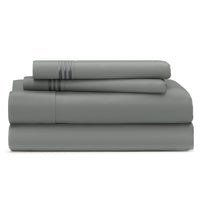
Why Your Bed Feels Hot Even With the AC On
Still waking up warm, sticky, or restless even though the AC is humming?
One study found that sleep was most efficient for older adults when nighttime bedroom temperatures stayed around 68°F to 77°F. When temps climbed from 77°F to 86°F, sleep efficiency dropped by 5% to 10%.[1]
A BIG deal when all you want is one peaceful, covers-on kind of night. But here is the part your thermostat cannot fix: Your room can feel cool while your bed still feels hot. That’s because your bed has its own tiny climate.
Your AC Cools the Room, But Your Bedding Controls the Bed
Once you slip under the covers, your body begins to release heat and moisture. That warmth does not just disappear. It can get trapped between your skin, sheets, mattress protector, and mattress.
Sleep researchers call this your bed microclimate, which is the pocket of temperature, humidity, and airflow around your body while you sleep.[2] It feels like this:
- Your sheets feel cool at first, then warm later.
- Your back or hips feel hotter than the rest of you.
- The bed feels a little damp, heavy, or clingy.
- You kick the covers off, then pull them back on five minutes later.
Sound familiar? The AC cools the room. Your bedding decides how that coolness feels against your skin.
Why Summer Humidity Makes Your Bed Feel Sticky
Summer sleep is not just about heat. It is about humidity, too.
When the air feels muggy, moisture evaporates more slowly. That can make it harder for your body to cool itself comfortably at night.[3]
So even if you are not waking up drenched, a little trapped warmth and moisture can make your bed feel:
- Less crisp
- More clingy
- Slightly damp
- Heavy instead of fresh
That is why soft sheets alone are not always enough. For summer, the layers closest to your body need to feel light, breathable, and smooth, not stiff or stuffy.

Why 100% Bamboo Sheets Are Best for Summer Sleep
If you are a hot sleeper, your sheets matter. A lot.
Cosy House 100% Bamboo Bed Sheets are crafted from 100% bamboo viscose for a soft, smooth, breathable feel that is especially dreamy in summer. They are designed to feel cool against the skin, wick away excess moisture, and help your bed feel lighter during warm nights.
And there is real fabric testing behind that cooling feel.
Cosy House bamboo viscose fabric tested up to 4x cooler than cotton in SGS Qmax cool-touch testing.[4] Qmax measures how cool a fabric feels when it first touches your skin.
Crisp.
Silky.
Fresh.
Cool-to-the-touch after a long, hot day.
Still Hot After Switching Sheets? Check Your Mattress Protector
Here is where most people stop too soon. They switch sheets. They lower the AC. And they still wake up hot.
The missing piece is often the layer underneath.
If your mattress protector feels slick, stiff, noisy, or plastic-like, it may be trapping heat right where your body presses into the bed. That means even breathable sheets are sitting on top of a warmer, less breathable layer.
The Cosy House Luxury Mattress Protector helps solve that “one layer down” problem. It adds waterproof mattress protection while keeping the sleep surface soft, quiet, and breathable beneath your fitted sheet.
So your bed still feels like a bed you want to sink into. Not a crinkly camping tarp disguised as bedding.

How to Keep Your Bed Cooler Without Lowering the AC
A better summer bed does not need to be complicated. Start with the layers your body touches most.
-
Check your mattress protector.
If it feels plastic-like, noisy, or warm under your fitted sheet, it may be working against your AC. -
Switch to breathable sheets.
The Cosy House 100% Bamboo Sheet Set feels smooth, cool, and lightweight against the skin. -
Lighten the top of the bed.
If you love a tucked-in feel, try a lighter quilt, breathable duvet cover, or lightweight comforter instead of piling on dense layers. -
Wash summer bedding more often.
Warm nights bring more sweat, sunscreen, body oils, and lotion into bed. Keep your layers fresh with Cosy House’s bed sheet washing and care guide.
A Cooler Night’s Sleep Starts One Layer Down
Summer sleep should not feel like a nightly negotiation with your thermostat. You should not have to choose between freezing the room, kicking off the covers, or waking up warm anyway.
If your bed still feels hot with the AC on, start where heat actually builds: the sleep surface.
The Cosy House Luxury Mattress Protector helps protect your mattress while keeping the layer beneath you soft, quiet, and breathable. Pair it with 100% Bamboo Bed Sheets for a summer sleep setup that feels cool the second you climb in.
Because the best summer bed does not just look fresh.
It feels fresh the second you climb in.
Use code BLOG10 for 10% off!

FAQ
Q: Why does my bed feel hot even with the AC on?
A: Your bed can feel hot even with the AC on because heat and moisture can build up inside the layers around your body. Your room may be cool, but your sleep surface can still feel warm, humid, or heavy if your bedding is not breathable.
Q: Can a mattress protector make you sleep hot?
A: Yes, some mattress protectors can feel hot if they are stiff, slick, plastic-like, or not very breathable. A breathable mattress protector can help protect your mattress while keeping the layer beneath your sheet softer and less stuffy.
Q: What bedding is best for hot sleepers in summer?
A: Hot sleepers should look for breathable, moisture-wicking bedding that feels light against the skin. A breathable mattress protector paired with 100% bamboo viscose sheets can help create a cooler-feeling summer sleep surface.
Q: Are bamboo viscose sheets good for summer?
A: Yes. Bamboo viscose sheets are a popular summer bedding choice because they feel smooth, breathable, lightweight, and cool to the touch. Cosy House bamboo viscose fabric also tested up to 4x cooler than cotton in SGS Qmax cool-touch testing.[5]
Q: How can I keep my bed cooler without lowering the AC?
A: Focus on the layers closest to your body. Choose a breathable mattress protector, switch to lightweight sheets, reduce heavy top layers, wash bedding regularly, and keep air moving in the room with a fan or open airflow when possible.
Resources:
-
Baniassadi, A., Manor, B., Yu, W., Travison, T., & Lipsitz, L. (2023). Nighttime ambient temperature and sleep in community-dwelling older adults. Science of the Total Environment, 899, 165623. https://pubmed.ncbi.nlm.nih.gov/37474050/
-
Okamoto-Mizuno, K., & Mizuno, K. (2012). Effects of thermal environment on sleep and circadian rhythm. Journal of Physiological Anthropology, 31, Article 14. https://doi.org/10.1186/1880-6805-31-14
-
Sleep Foundation. Humidity and Sleep: Optimize Your Sleep Environment. https://www.sleepfoundation.org/bedroom-environment/humidity-and-sleep
-
Harding, E. C., Franks, N. P., & Wisden, W. (2019). The Temperature Dependence of Sleep. Frontiers in Neuroscience, 13, 336. https://doi.org/10.3389/fnins.2019.00336
-
SGS Lab Test Report. (2024). Qmax testing of Cosy House bamboo viscose fabric.