The Sleep Mistakes People Make When Summer Starts to Cool Off
You went to bed warm. At 3 AM, you were awake, pulling a thin summer sheet up to your chin and finding it nowhere near enough.
Late summer does this. The afternoons are still warm, so nothing about your bed seems like it needs changing, and then the nights quietly drop out from under you.
Luckily, this may be less of a sleep problem and more of a bedding problem—and that’s much easier to fix.
Key Takeaways
-
Cooler late-summer nights can disrupt sleep, even when evenings still feel warm.
-
Check the overnight low before bed so you know whether to keep an extra layer within reach.
-
Layer breathable bedding so you can easily adjust when temperatures drop overnight.
-
Temperature-regulating sheets help prevent overheating and chills as sleep temperatures change.
-
Bamboo viscose sheets can work year-round by helping manage heat and moisture.
Why Does My Bedroom Feel Hot at Bedtime but Cold by Morning?
Because two separate things cool down overnight, and your bedding can't respond to either one.
The first is you. Your body starts cooling itself in the evening on purpose and keeps cooling all night, bottoming out in the early morning hours. It's part of how you fall asleep in the first place.
The second is the air outside. Overnight lows start sliding well before afternoon highs do, so your afternoons still say summer while your nights have moved on.
Which leaves you going to bed a little too warm and waking up genuinely too cold. And getting too cold may be the harder problem: when researchers compared sleep across a range of room temperatures, the chilly nights disrupted it more than the hot ones did.
None of that is a fluke. It's what happens when a bed can only do one temperature.

5 Late-Summer Sleep Mistakes & How to Fix Them
None of these would have been considered mistakes a month ago, which is exactly why they’re so easy to miss.
Mistake #1: Ignoring the Overnight Low
Most of us keep two beds: a summer one and a winter one. Around Memorial Day, the heavy stuff goes in the closet, and after the first real cold snap, it comes back out.
That works fine in July, and it works fine in January, but not always in the weeks in between, when the deciding factor isn't the month anymore. It's the night. One is 78 degrees, the next is 58, and plenty of them manage both before sunrise.
The fix: Check the overnight low before bed instead of the day's high. That's the number your bed actually has to be ready for, and it's the one almost nobody looks at.
Mistake #2: Using an All-or-Nothing Bedding Setup
If you tend to sleep hot, chances are you've been sleeping under just a sheet all summer, and plenty of us have. It was the right call when the nights were warm, and anything more felt like too much. It's the wrong call on a 58-degree night, when there's nothing on the bed to reach for at 3 AM.
Comforter sleepers hit the same wall from the other side, one leg hanging out all night. Either way, your bed has two settings, and neither of them is "a little warmer." So you improvise. Leg out, leg back in, covers up, covers down, half awake for twenty minutes at a stretch.
The fix: Give your bed a middle option. Keep a light extra layer folded at the foot of the bed each night. A fleece blanket works well here: light enough for warmer nights, but easy to pull up when the temperature drops. Reaching for it takes seconds, instead of spending the next twenty minutes adjusting your covers.
Mistake #3: Adding Heavy, Non-Breathable Layers Too Soon
One chilly night convinces us summer is over, and the heaviest comforter comes straight out of the closet, usually with a fleece throw over it for good measure.
Then you wake up in the middle of the night, clammy and somehow cold, under more blankets than you started with.
Moving moisture is harder for a bed than moving heat, especially with dense or heavily filled fabrics. Stacking these layers traps body moisture, creating damp fabrics that pull heat away from your skin quickly and leave you cold.
The fix: Add warmth in stages, using materials that breathe. Lighter, breathable layers give you more flexibility than jumping straight to one heavy layer. For example, our Luxury Down Alternative Comforter is much more forgiving on the nights that swing back warm since the bamboo viscose in its shell keeps the surface against your skin breathable.
Mistake #4: Running the AC on Cool Nights Out of Habit
Plenty of us are still running the air conditioning on nights when the outside air would happily do the job for free. Partly habit, partly the assumption that colder always means better.
But cooling a room that's already cooling itself is how you end up shivering before sunrise with a bigger electric bill to show for it.
If you sleep hot, this one is especially easy to miss, since the AC has been solving your problem all summer. It's worth knowing your thermostat only reaches the room. The pocket of air and moisture between you and your sheets, which is where you actually sleep, does its own thing.
→ More on that in Why Your Bed Feels Hot Even With the AC On.
The fix: When overnight temperatures start dipping into the 60s, you may not need to run the AC as aggressively. Turn off the AC or raise its temperature before bed. You can also open a window or use a low-setting fan to circulate air without chilling the space.
Mistake #5: Using Sheets That Only Work in One Season
Here's the one almost nobody thinks about, and it's the one that matters most.
Every layer on your bed is adjustable except one. You can kick off a comforter, pull up a blanket, or fold a quilt down to the foot of the bed. All of that is available to you in the middle of the night without opening your eyes.
Your sheets aren't. Whatever's on the mattress is what you're sleeping against all night, in whatever temperature the night turns into.
So your sheets are the only layer that has to handle the whole range on their own. That's what makes "summer sheets" and "winter sheets" a broken idea: a sheet chosen for one season will let you down twice a year.
The fix: Choose sheets based on temperature regulation rather than store feel, and keep them on year-round. Bamboo viscose can help regulate temperature across seasons, leaving your top layers to handle the extra warmth.

How to Layer a Bed for Warm Days & Cool Nights
Three layers, and the trick is to adjust them rather than swap them out.
-
Your sheets stay on the bed no matter what the night is doing.
-
A fleece blanket or Luxury Quilt Set sits folded at the foot, within reach the moment the temperature drops.
-
A breathable comforter or duvet earns a spot all year, because you can fold it back instead of taking it off.
Set up that way, a 20-degree swing between bedtime and sunrise stops being an event. It's just a blanket you pull up in your sleep.
→ There's a styling side to layering too, and we covered that in 5 Designer Bed Layering Tricks You Can Copy Tonight.
What Makes Bed Sheets Temperature-Regulating?
Breathability and moisture movement—not thread count alone.
A sheet that traps heat fails you on the warm nights, and one that traps moisture fails you on the cool ones. That's not a small effect, either. When researchers looked at bedding fabrics in cooler rooms, the fabric itself changed the conditions people slept in.
Bamboo viscose is well-suited to both jobs, and fabric weight matters as much as the fiber does. A lighter sheet breathes on a warm night without feeling thin on a cool one, and that pairing is what lets a single sheet set cover the full temperature range instead of half of it.
|
What bamboo viscose does |
What it doesn’t do |
|
Regulates temperature in both directions |
Add any warmth of its own |
|
Moves body heat away from your skin |
Trap heat on a warm night |
|
Moves moisture out instead of holding it |
Leave you damp, uncomfortable, and chilled |
|
Lets your top layers set the warmth |
Fight the blanket you pull up |
|
Stays on the bed year-round |
Need to be swapped out every season |

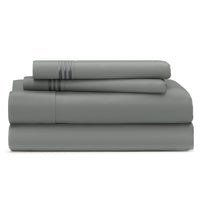
Of the five fixes on this list, this is the only one you have to do once. Our bestselling 100% Bamboo Bed Sheets are made from pure bamboo viscose at a light 135 grams per square meter, perfect for any season or in between.
BONUS: Code BLOG10 takes 10% off, and using it now means the fix is on your bed before the cold nights show up rather than after.
Frequently Asked Questions
What's the best bedroom temperature for sleep? Most guidance for adults lands between 60 and 67 degrees. Most of us sleep warmer than that, though. In an analysis of more than 3.75 million nights, bedrooms sat above 70 degrees on roughly 69% of them, and the warmer rooms tracked with worse sleep.
How do I know if my bedroom or bedding is making me cold? There's a quick test. If you're comfortable getting into bed and cold a few hours later, it's usually the bedding, because the room didn't change much overnight but your body did. If you're cold from the moment you get in, that one's the room.
Are bamboo sheets good for fall and winter? Yes. Our bamboo sheets are temperature-regulating and made for every season: cool in summer, cozy in winter. Bamboo viscose regulates rather than insulates, so it isn't trapping heat when it's warm out or pulling heat off you when it's cold. The added warmth comes from the layers on top.
Do bamboo sheets feel cold when you first get into bed? They feel cool to the touch, and that's measurable. On the lab scale for how cool a fabric feels against skin, ours reads well above cotton.† That first-contact coolness passes quickly once the fabric warms to your skin, which is the difference between a sheet that feels cool and a bed that stays cold.
How to Prepare Your Bed for Cooler Nights
Your bed isn't broken, and neither is your sleep. The setup just hasn't caught up to the nights yet.
Whether the nights are warmer or cooler, your bed can handle both, with the right sheets.
When you're ready, code BLOG10 takes 10% off our 100% Bamboo Bed Sheets, or any of your other bedding needs.

† Qmax value from SGS lab test report of Cosy House fabric.