Sleeping Hot This Spring? 3 Bedding Fixes To Sleep Cooler
Spring doesn’t just change the weather.
It changes how you sleep.
Longer daylight hours shift your internal clock. Nighttime temperatures fluctuate. Humidity rises. And suddenly, the bed that felt perfect in January feels heavy, warm, and harder to settle into.
If you’ve been waking up overheated, kicking off the covers, or feeling restless at 3 a.m., your body isn’t the problem.
Your bedding might be.
The good news? You don’t need a full bedroom makeover. You need a more breathable, temperature-balanced sleep setup.
Let’s break down why spring sleep feels different, and the three bedding upgrades that can help you sleep cooler and more comfortably.
Why Spring Sleep Feels Different

Your body temperature naturally drops at night to help you fall into deeper sleep. Research shows that core temperature can decrease by 1–2°F during a normal sleep cycle [1]. This cooling process helps you:
- Fall asleep faster
- Stay asleep longer
- Enter deeper sleep stages
But when bedding traps heat or holds moisture, your body has to work harder to regulate itself.
Even mild overheating can trigger micro-awakenings: tiny disruptions you may not remember, but your body does. Over time, those interruptions can leave you feeling less rested in the morning [2].

Now layer in those pesky springtime conditions:
1. Warmer Air Holds More Moisture
Humidity makes bedding feel heavier against your skin, even when temperatures aren’t dramatically higher.
2. Fluctuating Temperatures
Cool evenings can turn into warmer early mornings. If your bedding only insulates (instead of adapts), you’ll wake up too warm.
3. Reduced Evaporation
When moisture can’t evaporate easily, your skin feels warmer and slightly damp. That discomfort alone can disrupt sleep.
Winter bedding is designed to trap heat.
Spring bedding should release it.
A spring-ready bed isn’t about less comfort.
It’s about adaptable comfort.
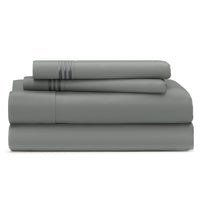
1. Start with the Layer That Controls Temperature: Your Sheets
If you change one thing this spring, make it your sheets.
Sheets sit directly against your skin. That makes them the most important layer for temperature regulation and moisture control.
Before your comforter.
Before your mattress.
Bed sheets determine whether heat escapes or gets trapped.
What to Look for in Cooling Sheets
Not all “soft” sheets are breathable. Fabric weight, fiber type, and weave all affect airflow.
For spring, and for hot sleepers year-round, look for sheets that are:
- Breathable and lightweight
- Moisture-wicking
- Temperature-balancing (not heat-retaining)
- Smooth without feeling dense or heavy
Heavier materials like flannel or traditional cotton are designed to insulate. That’s helpful in winter. But in fluctuating temperatures, insulation can trap excess warmth.
Breathable fabrics like 100% bamboo viscose allow airflow and help release heat rather than store it. That supports your body’s natural cooling process; not just in spring, but all year.
If your bed feels warm before you fall asleep, your sheets are often the starting point.
Upgrade the base layer, and everything else works better.
2. Refresh What’s Underneath: Mattress + Protector
Most people wash their sheets in the spring.
Fewer think about the mattress.
But your mattress is the foundation of your sleep environment, and it absorbs more than you realize.
With open windows, rising humidity, and everyday moisture from normal sleep, mattresses can quietly collect dust, buildup, and trapped warmth over time. Even if your sheets are freshly washed, the surface underneath can still feel heavy or less breathable.
Spring is the perfect time to reset the entire sleep system, not just the top layer.
Start with a Simple Mattress Refresh
It’s time for some spring cleaning for your sleep.
- Vacuum the surface thoroughly to lift dust and everyday buildup
- Let it air out near an open window for a few hours to release trapped warmth
- Spot-clean visible stains to keep the surface feeling fresh
- Rotate the mattress to promote even wear and long-term support
When the base layer of your bed feels refreshed, the entire room feels calmer. And your sleep feels less stuffy, less dense, and more breathable.
Then Add a Breathable Mattress Protector
After refreshing the mattress itself, protect it with a breathable, waterproof mattress protector.
The right protector shields against spills and everyday moisture while still allowing airflow. That balance matters, especially in spring, when humidity can make bedding feel warmer and heavier.
A high-quality protector should:
- Support airflow
- Help reduce moisture buildup
- Maintain a cooler sleep surface
And most importantly, it shouldn’t feel stiff or plasticky. It should feel soft, quiet, and invisible, protecting your mattress without interfering with comfort or temperature regulation.
3. Rethink Your Pillow (Yes, It Affects Temperature)
Your pillow isn’t just about neck support.
It’s where your body releases heat all night long.
Because your head and neck play a major role in temperature perception, even slight heat buildup here can make your entire body feel warmer. That’s why you might kick off the covers, even if the rest of you isn’t actually overheating.
Over time, pillows can:
- Lose loft and structure
- Flatten unevenly
- Retain warmth
- Reduce airflow around the head and neck
And when airflow decreases, heat lingers.
If your pillow is 12–18 months old, feels dense, or doesn’t bounce back when folded in half, it may no longer support proper ventilation or alignment.
What to Look for in a Cooling-Friendly Pillow
Spring is a smart time to upgrade to a pillow that supports both airflow and structure. Look for:
- Adjustable shredded memory foam fill for customizable comfort
- Breathable outer covers that encourage circulation
- Shape-retaining construction to prevent flattening
- Airflow-friendly materials designed to minimize heat retention
Unlike solid foam cores that can trap warmth, adjustable fill allows air to move more freely, helping regulate temperature throughout the night.
When your pillow allows airflow, you’re less likely to toss, shift, or flip it in search of the “cool side.”
Don’t Skip the Pillow Protector
If you’re upgrading your pillow, protect it properly.
A breathable, waterproof zippered pillow protector adds an extra layer of defense without trapping heat. Look for one that:
- Encourages airflow for cooler sleep
- Helps protect your pillow from sweat and spills
- Zips fully closed for secure coverage
- Feels soft and noise-free (no crinkling)
A bamboo viscose blend is especially helpful here. It supports breathability while shielding your pillow from everyday moisture that can build up during warmer, more humid months.
How to Build a Breathable Sleep System

Here’s the bottom line:
Better spring sleep isn’t about removing blankets.
It’s about smarter layers.
When airflow, moisture control, and temperature balance work together, your body can cool itself naturally (without kicking off the covers at 3 a.m.).
If you’re ready to refresh your bedroom for spring, explore breathable bedding designed to support cooler, more comfortable sleep.
Use code BLOG10 for 10% off your spring refresh today!

Resources:
-
Okamoto-Mizuno K, Mizuno K. Effects of thermal environment on sleep and circadian rhythm. J Physiol Anthropol. 2012 May 31;31(1):14. doi: 10.1186/1880-6805-31-14. PMID: 22738673; PMCID: PMC3427038. https://pmc.ncbi.nlm.nih.gov/articles/PMC3427038/
-
Guillaume Chevance, Kelton Minor, Constanza Vielma, Emmanuel Campi, Cristina O’Callaghan-Gordo, Xavier Basagaña, Joan Ballester, Paquito Bernard, A systematic review of ambient heat and sleep in a warming climate, Sleep Medicine Reviews, Volume 75, 2024, 101915, ISSN 1087-0792, https://doi.org/10.1016/j.smrv.2024.101915.