Your Bed Is Still in Winter Mode (And It’s Ruining Your Sleep)
You wouldn’t wear a heavy winter coat on a warm spring day—so why are you still sleeping in winter layers?
If your bed is still optimized for winter, it could be trapping heat night after night. That can leave you tossing, turning, or sleeping hot and waking up warmer than you’d like.
Most of us forget to make the shift—not because we don’t want to, but because we’re not sure where to start.
So here are a few simple ways to refresh your bed and start sleeping cooler this season.
The Hidden Reason You’re Sleeping Hot
Winter bedding is designed to do one thing really well: hold onto heat.
Think insulating comforters, thick layers, and less breathable fabrics. Perfect for cold nights. Not so great when temperatures start to rise.
Your body actually needs to cool down to fall asleep and stay asleep. When your sleep environment is too warm, it can interfere with that natural process—making it harder to reach deeper, more restorative sleep.[1]
In fact, your bedding can trap up to a few degrees of extra heat (around 5°F)—more than enough to interfere with your body’s natural sleep cycle.[2,3,4]
And when heat builds up, moisture often follows—leading to that slightly damp, uncomfortable feeling that can wake you up during the night and leave you less rested by morning.

Signs Your Bed Is Still in Winter Mode
Not sure if this applies to you? Here are a few subtle signs your bed hasn’t caught up to the season yet:
-
You wake up feeling warm or slightly sweaty
-
You kick off your covers during the night
-
Your bed feels heavy or stuffy
-
You’re constantly adjusting layers to get comfortable
-
You’re sleeping enough hours, but not waking up refreshed
What’s Still “Winter” in Your Bed
Even as the weather changes, these cold-weather staples often stick around longer than they should:
-
Heavy duvets that trap body heat
-
Non-breathable mattress protectors that seal in warmth and moisture
-
Thick pillow fills that hold heat overnight
-
Layered throws and blankets adding insulation you no longer need
On their own, they might not seem like a problem—but together, they can create a warmer, less breathable sleep environment than your body needs.

How to Reset Your Bed for Cooler Sleep This Spring
It doesn’t take much to shift your bed out of winter mode. A few small updates can make a big difference.
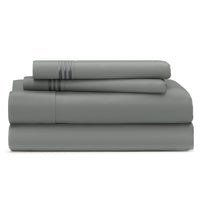
1. Switch to Breathable Sheets
Look for lightweight, moisture-wicking fabrics that allow airflow and help regulate temperature throughout the night.
2. Swap Your Duvet or Comforter
Trade heavy winter bedding for a lighter option designed for year-round comfort or warmer seasons.
3. Rethink Your Layers
Instead of stacking thick blankets, opt for a layering strategy—light layers you can easily adjust as your body temperature changes.
4. Refresh Your Mattress Protector
Your protector plays a bigger role than you think. Look for a breathable option that helps maintain a cooler, fresher sleep environment.
5. Wash and Fully Reset Your Bedding
Start the season with a clean slate. Washing your sheets, pillowcases, and comforter helps remove body oils and moisture—so your bed feels lighter, fresher, and more comfortable from the first night.
Why Breathable Materials Like Bamboo Make a Difference
Sleeping cooler isn’t just about comfort—it’s about better sleep quality.
Materials like bamboo viscose are designed to be breathable and moisture-wicking, helping your body release heat instead of holding on to it. That makes it easier to maintain the lower temperature your body needs to stay in deeper, more restorative sleep.
The result?
Lighter, drier, more comfortable nights—and better mornings to match.

Make the Switch to Cooler, More Comfortable Sleep
At Cosy House, everything we design is made to support better sleep through better materials.
-
100% Bamboo Sheets for breathable, moisture-wicking comfort
-
Luxury Down Alternative Comforter designed to regulate temperature—not retain heat
-
Luxury Mattress Protector that protects without sacrificing airflow
Because your bed should adapt to the season—just like you do.
P.S. Our bestselling bamboo sheets are now available in a fresh floral print in soft aqua tones—light, airy, and perfect for spring.
Refresh Your Bed for the Season
If your bed is still holding onto winter, now’s the time to reset.
Make a few simple changes, and you may be surprised how much better your sleep feels.
Take 10% off your upgrade with code BLOG10.

Sleep cooler. Feel more comfortable. Wake up refreshed.
Resources:
-
Hu, S., Liang, S. (2023). Thermal Comfort in Sleeping Environments. In: Wang, F., Yang, B., Deng, Q., Luo, M. (eds) Personal Comfort Systems for Improving Indoor Thermal Comfort and Air Quality. Indoor Environment and Sustainable Building. Springer, Singapore. https://doi.org/10.1007/978-981-99-0718-2_3
-
Okamoto-Mizuno, K., & Mizuno, K. (2012). Effects of thermal environment on sleep and circadian rhythm. Journal of Physiological Anthropology, 31(1), 14. https://doi.org/10.1186/1880-6805-31-14
-
Kräuchi, K., Cajochen, C., Werth, E., & Wirz-Justice, A. (2000). Functional link between distal vasodilation and sleep-onset latency? American Journal of Physiology-Regulatory, Integrative and Comparative Physiology, 278(3). https://doi.org/10.1152/ajpregu.2000.278.3.r741
-
Caddick, Z. A., Gregory, K., Arsintescu, L., & Flynn-Evans, E. E. (2018). A review of the environmental parameters necessary for an optimal sleep environment. Building and Environment, 132, 11–20. https://doi.org/10.1016/j.buildenv.2018.01.020